Central Bank Watchlist: March 2026 Meeting Expectations
A crowded central bank calendar in March could inject fresh volatility into the forex market as traders brace for a series of key policy decisions.


Key Points
- The Iran conflict continues to influence price action in the global forex market, with safe-haven flows and shifting risk sentiment driving sharper, more reactive moves across the major currency pairs.
- The next major focus for forex traders is March’s central bank calendar, beginning with the Federal Reserve’s March 18 meeting, where markets are overwhelmingly leaning toward a hold.
- Several other central banks will also be closely watched this month: the Bank of England no longer looks like a near-term cut story, with markets now expecting a hold as inflation and higher oil prices complicate the easing case; the Reserve Bank of Australia is still treating March as a “live” meeting, with a hike now potentially in the cards; and the Swiss National Bank has signaled a greater willingness to step in if franc strength becomes disruptive.
- The Bank of Japan is also expected to hold in March, but with USD/JPY back above 159, intervention risk is back on the radar, leaving the yen vulnerable to sharp moves if Japanese officials step up their verbal warnings.
The Iran conflict continues to hang over foreign-exchange markets, where geopolitical headlines have revived demand for safe-haven currencies, stoked volatility, and made traders more tactical as they try to navigate a fast-moving market.
The next big test for FX markets now comes from central banks. The Federal Reserve’s setup looks relatively straightforward in the base case, with markets overwhelmingly priced for a hold (see graphic below). After the Fed meeting, the focus will shift to the rest of March’s major policy meetings—and what they could mean for the FX landscape in the weeks ahead. Traders should keep in mind that this remains a highly fluid backdrop, meaning sentiment and market pricing can shift quickly as events develop.
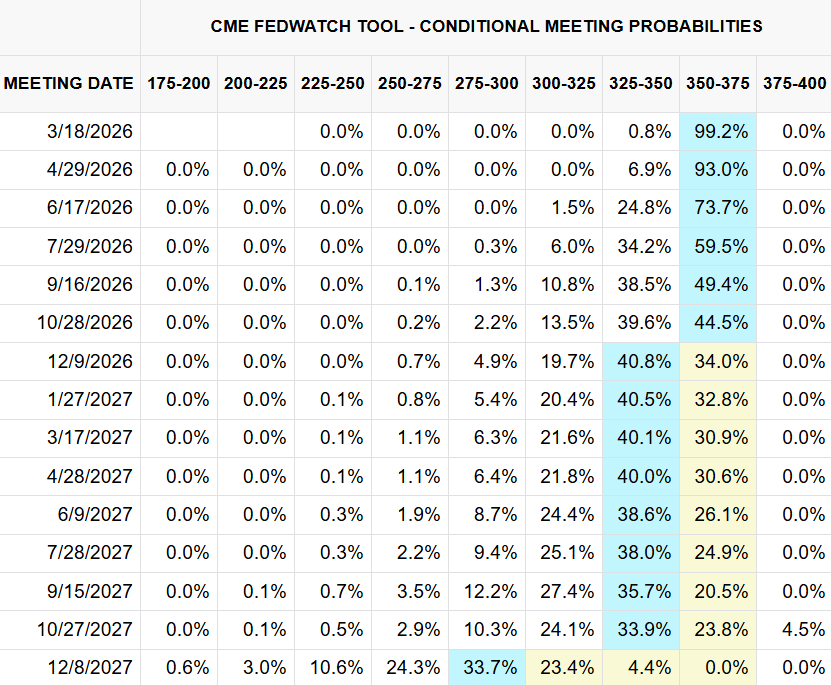
Current expectations for upcoming central bank meetings
- Federal Reserve (March 18): As illustrated in the above graphic, the consensus expectation is a firm hold—CME FedWatch is implying roughly 99% odds of “no change” and the first cut likely coming in September. The more important variable is tone. If the Fed leans into a wait-and-see message given the headline risk, it keeps the market’s focus on war-driven swings in risk sentiment—while pushing the next meaningful policy checkpoint toward the April 29 meeting.
- Bank of England (March 19): Not long ago, the Bank of England (BoE) looked like one of the central banks most likely to deliver a policy move in March, with markets leaning toward a rate cut this month. However, expectations have shifted. The BoE is now widely expected to hold rates at 3.75% on March 19, as sticky inflation and the recent rise in oil prices have made the near-term easing case look less straightforward.
- Bank of Japan (March 18–19): For the Bank of Japan, expectations still lean toward a hold in March. War-driven volatility and higher oil prices have strengthened the case for patience, but yen weakness is bringing intervention risk back into focus with USD/JPY climbing above 159. That means USD/JPY traders may need to stay alert not just to the policy decision itself, but also to any shift in official rhetoric or market rumors around intervention, which can quickly jolt the pair even without an immediate move from the BOJ.
- European Central Bank (March 19): For the European Central Bank (ECB), March looks like a “hold”—not because the inflation story is suddenly simple, but because the war makes it harder to separate signal from noise. Markets have flirted with the idea of an ECB hike later this year as disruption risk threatens to push inflation higher, yet the same shock can also depress activity and complicate the growth outlook. That “two-way risk” is why policymakers have been leaning toward patience.
- Reserve Bank of Australia (March 16–17): The Reserve Bank of Australia (RBA) has made it clear that March remains a “live” meeting. And according to a recent poll by Reuters, a 25-basis-point hike at the March 16–17 meeting could now be in the cards. Governor Michele Bullock has pushed back against the idea that the Bank will simply wait for the next quarterly inflation report, reinforcing the view that policymakers are prepared to move if conditions warrant.
- Bank of Canada (March 18): After cutting rates repeatedly through 2025, the Bank of Canada has shifted into pause mode. Officials held at 2.25% at the last meeting (Jan. 28) and highlighted elevated trade uncertainty as a key reason the next move is harder to predict. That framing keeps March looking like another “hold,” unless growth or labor data deteriorates enough to force the easing debate back to the front of the line.
- Swiss National Bank (March 19): The Swiss National Bank’s focus is less about rates and more about the domestic currency. After safe-haven flows pushed CHF higher, policymakers have signaled a greater willingness to intervene against “excessive” appreciation—suggesting March could be more about messaging (and potential FX ops) than a shift in rates.
- Reserve Bank of New Zealand: There is no March meeting; the next meeting is scheduled for April 8. That leaves NZD/USD more exposed to global risk sentiment and shifting expectations abroad, rather than a near-term domestic catalyst.
For updated timings and expectations, check out the tastyfx Economic Calendar.
What This Could Mean for Key Currency Pairs
With those policy expectations in mind, the next question is how these decisions—and the guidance that comes with them—could translate into price action. Here’s what the current setup may mean for the major forex pairs.
If the Fed holds and avoids any major surprise, the dollar is likely to trade more off geopolitical headlines than off the meeting itself. Further escalation in the Middle East could quickly push the dollar higher on safe-haven demand, while signs of stabilization could weaken that support and send the dollar modestly lower as risk appetite improves.
For sterling (GBP/USD), a rate cut now looks less likely than it did not long ago, which could ease some of the near-term pressure on GBP/USD. That said, the currency will still be sensitive to the BoE’s tone: a cautious hold could offer some support, while any guidance that leans more dovish than expected could still weigh on the pound.
For the yen (USD/JPY), a March hold from the BoJ still looks like the most likely outcome. But with USD/JPY back above 159, the more immediate risk may come from Tokyo rather than the central bank itself. Any escalation in official warnings or renewed intervention speculation could quickly disrupt the pair, even if policy remains unchanged.
For the euro (EUR/USD), the ECB’s “sit-tight” posture implies less policy-driven momentum, which leaves EUR/USD trading more off the dollar and the war premium than off euro-area developments. The result is likely a more range-bound setup—higher if safe-haven flows ease, lower if the conflict premium builds.
In Australia (AUD/USD), the RBA keeping March “live” creates clearer upside risk for AUD/USD. A hike—or even a hawkish hold—could lift the pair. But if the Bank puts more emphasis on war-driven uncertainty and downside growth risks, the Aussie could revert to trading like a risk-sensitive currency, leaving AUD/USD exposed if safe-haven demand intensifies.
In Switzerland (USD/CHF), the SNB’s signaling adds a wrinkle to the usual safe-haven playbook. The franc can still strengthen in periods of risk aversion, driving USD/CHF and EUR/CHF lower, but increased intervention risk could make those moves choppier and less likely to develop into a sustained one-way rally.
More broadly, this remains a market shaped by two unstable forces: geopolitics and shifting central bank expectations. Both can change quickly, and when they do, forex pricing can adjust in a hurry. That is why discipline matters here. In an environment like this, tighter risk controls, smaller positions, and a more tactical mindset may be warranted, because volatility can accelerate quickly and market depth can fade once price action turns more aggressive.
How to trade US dollar
- Open an account to get started, or practice on a demo account
- Choose your forex trading platform
- Open, monitor, and close positions on USD pairs
Trading forex requires an account with a forex provider like tastyfx. Many traders also watch major forex pairs like EUR/USD and USD/JPY for potential opportunities based on economic events such as inflation releases or interest rate decisions. Economic events can produce more volatility for forex pairs, which can mean greater potential profits and losses as risks can increase at these times.
You can help develop your forex trading strategies using resources like tastyfx’s YouTube channel. Our curated playlists can help you stay up to date on current markets and understanding key terms. Once your strategy is developed, you can follow the above steps to opening an account and getting started trading forex.
Your profit or loss is calculated according to your full position size. Leverage will magnify both your profits and losses. It’s important to manage your risks carefully as losses can exceed your deposit. Ensure you understand the risks and benefits associated with trading leveraged products before you start trading with them. Trade using money you’re comfortable losing.