USD/JPY Intervention Bought Time, but did the Trend Change?
USD/JPY remains the market’s pressure point after Japan stepped in to buy Japanese Yen.


USD/JPY stayed under heavy scrutiny on Friday after Japan reportedly intervened in New York trading on Thursday, buying Japanese Yen and selling U.S. Dollars as the pair’s move toward the mid-160s became politically and economically dangerous. The timing matters. Japan is already dealing with an Iran-driven energy shock, and a weaker Japanese Yen makes imported fuel more expensive, worsens the terms of trade, and pushes household inflation pain higher. The BOJ then kept rates unchanged at 1%, with one dissent in favor of a 25-basis-point hike, which tells the market the central bank is still moving gradually even as the currency problem becomes more acute. That is why intervention helped, but did not fully change the conversation. It slowed the move, punished crowded longs, and bought time. It did not erase the U.S.-Japan rate gap.
The process matters as much as the price action. In Japan, the Ministry of Finance makes the intervention decision, and the BOJ typically executes as agent. The sequence usually starts with verbal warnings, then rate checks, where authorities ask banks for live dollar-yen quotes. A rate check is not the trade itself; more like the market equivalent of loading a shotgun loudly. If they move, Japan sells U.S. Dollars from its reserves and buys Japanese Yen, which drains yen liquidity from the system. That is why traders look at BOJ current account projections afterward. An unusually large projected funds shortfall can reveal the rough size of the operation, and today’s estimates pointed to a potentially massive yen-buying effort. Intervention can create violent downside gaps in USD/JPY, while a durable Japanese Yen recovery probably requires either lower U.S. yields, faster BOJ tightening, or both.
USD/JPY Daily Price History
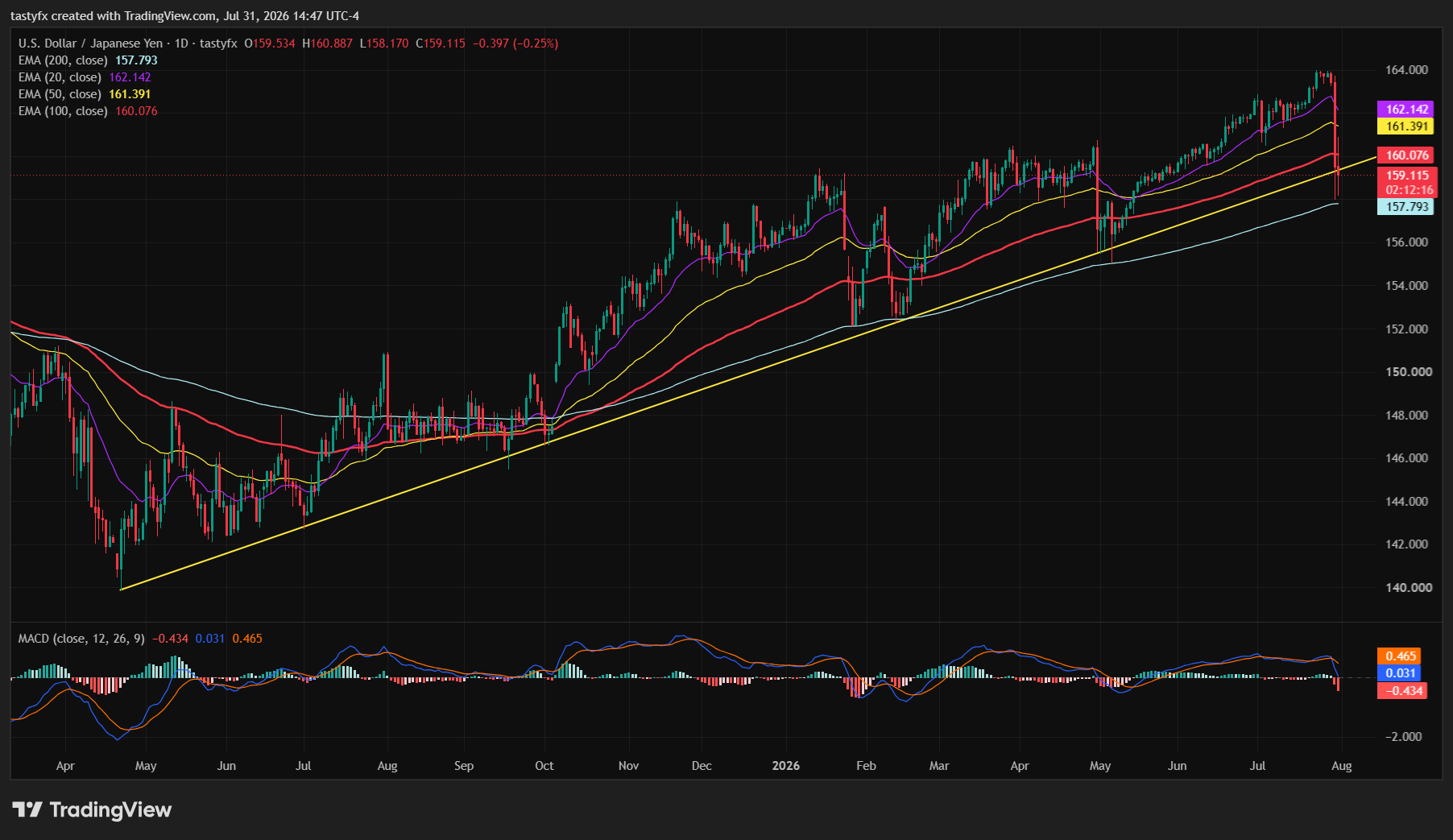
USD/JPY has sliced through the short-term moving averages and is now testing the more important support shelf. MACD is rolling over and the histogram has flipped sharply negative, which says upside momentum has been damaged. Stochastics have also plunged from overbought toward the lower end of the range, which confirms the near-term shift from trend-following to liquidation. The key point: this is no longer a clean long U.S. Dollar/Japanese Yen chart, but rather an intervention-risk chart sitting on trend support.
For traders looking on the Yen’s side, chasing down here is probably imprudent and a more patient approach could be selling failed rallies back into 160.50-162.00, where trapped longs and moving-average resistance should show up. If USD/JPY cannot reclaim that zone quickly, the intervention candle becomes overhead supply. Closing below the rising trendline from 2025 would make the next downside pocket just under 158.00 at the 200 day EMA before a larger range of 156.00 is realistic, but it would likely require participation from U.S. Treasury yields and a belief that selling Yen is fraught in the face of interventionist threats.
Trading forex requires an account with a forex provider like tastyfx. It’s important to manage your risks carefully as losses can exceed your deposit. Ensure you understand the risks and benefits associated with trading leveraged products before you start trading with them.