Will the Bank of Canada Cause a USD/CAD Breakout?
The Bank of Canada kicks off a busy stretch of central-bank meetings on July 15, with USD/CAD hovering near the pivotal 1.4150 level.

Key Points
- The Bank of Canada is widely expected to hold its policy rate at 2.25%, putting the spotlight on inflation risks, updated forecasts, and Governor Tiff Macklem’s guidance.
- USD/CAD remains near the upper end of its six-month range, but has edged lower recently, and spent much of the past month oscillating around 1.4150.
- With the pair compressed inside that narrower range, a hawkish hold could push USD/CAD below 1.4100, while a softer message—especially alongside firm U.S. data—could send it back toward 1.4200.
The Bank of Canada will kick off an important stretch of central-bank meetings when it announces its latest policy decision on July 15. Four other major decisions will follow later in the month, with the European Central Bank meeting on July 23, the Federal Reserve on July 29, the Bank of England on July 30, and the Bank of Japan on July 30–31.
Trading around 1.4150, the pair is trading at an important technical level. And with the policy outlook still finely balanced, the July 15 decision could provide the catalyst for the next meaningful move.
Bank of Canada Expected to Hold Rates Steady at 2.25%
The Bank of Canada is widely expected to leave its overnight rate unchanged at 2.25%. All 36 economists in a July 7–10 Reuters poll predicted a hold, with many anticipating that rates could remain at current levels through the summer, and possibly beyond.
That means the decision itself may offer little surprise. The bigger question is whether policymakers sound more concerned about inflation—or more focused on the remaining weakness in the Canadian economy.
At its previous meeting on June 10, the Bank of Canada held rates at 2.25% and described an economy that had weakened. Gross domestic product declined slightly during the first quarter, business investment remained soft, and uncertainty surrounding U.S. trade policy was still elevated. At the same time, policymakers warned that they would not allow higher energy costs to develop into persistent inflation.
The Bank’s subsequent deliberations showed how finely balanced the situation had become. Policymakers did not want to raise rates in response to a temporary oil shock that could fade before tighter policy took effect. But they also acknowledged that waiting too long could eventually require a more aggressive response if higher energy costs spread into wages and broader consumer prices.
The latest data provide arguments for both sides. Canadian inflation accelerated to 3.2% in May, above the top of the Bank’s 1–3% control range, although gasoline accounted for much of the increase. Excluding gasoline, inflation was a more manageable 2.2%.
The labor market has also improved without looking especially hot. Canada added roughly 18,000 jobs in June, while unemployment edged down to 6.5%. That was better than expected, but employment growth remained modest enough that it is unlikely to force an immediate policy move.
Energy markets add another layer to the outlook. Oil prices have fallen sharply from their spring highs and declined again in early July, reducing some of the immediate inflation pressure facing both the Bank of Canada and the Federal Reserve. But softer oil can also remove an important source of support for the Canadian dollar, given Canada’s role as a major energy exporter.
The most likely outcome is therefore another hold, accompanied by a message that rates could eventually move in either direction. A clearer warning about persistent inflation would make the decision feel hawkish. Greater emphasis on excess capacity, trade uncertainty, and cooling energy prices would lean more dovish.
What the Decision Could Mean for USD/CAD
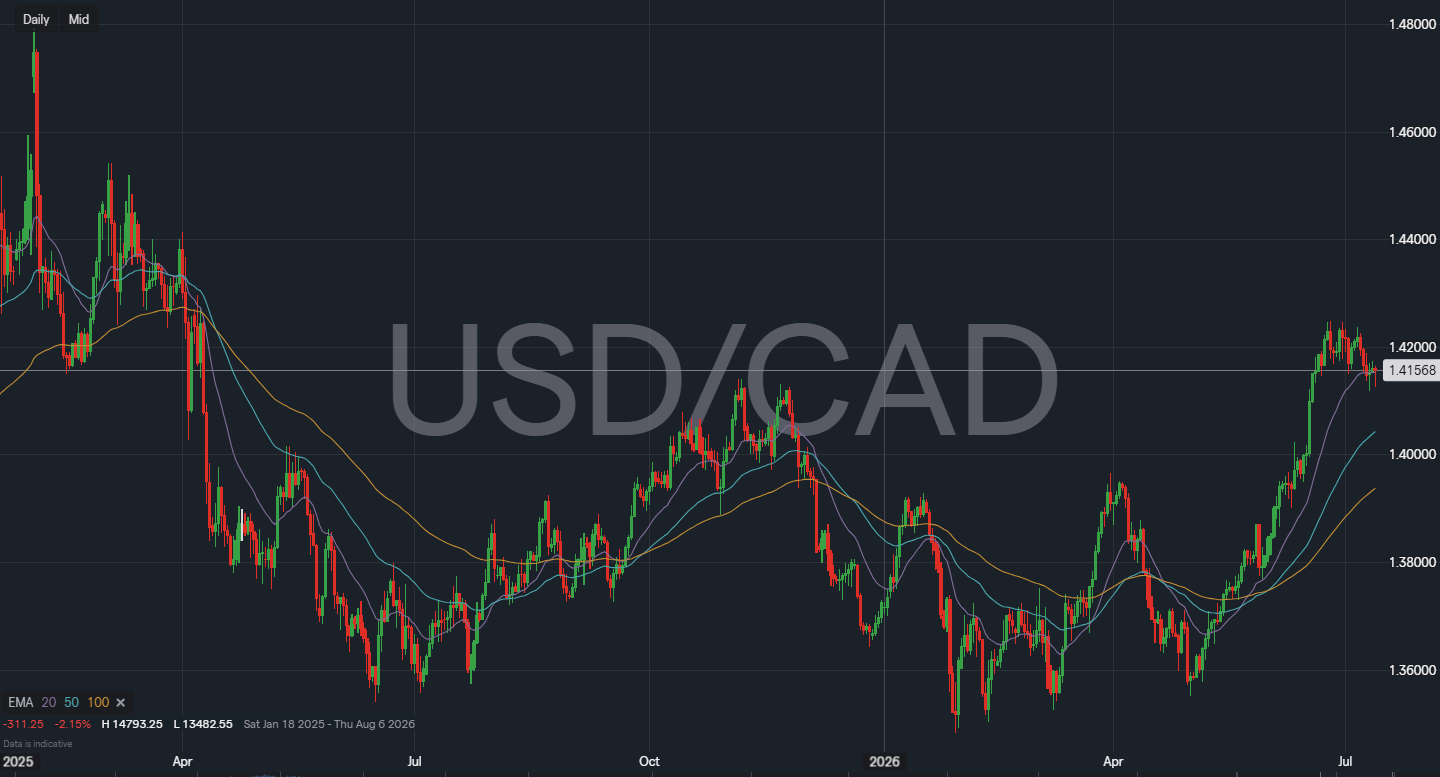
USD/CAD is sitting near 1.4150 heading into the Bank of Canada decision, placing the pair almost directly between two important near-term levels. Over the past month, trading has largely compressed into a narrow band between roughly 1.4100 and 1.4200, even as the broader six-month range has stretched from approximately 1.3500 to 1.4250. This makes the July 15 decision a major potential catalyst to break out in either direction.
A hawkish hold from the Bank of Canada could strengthen the loonie. That outcome might include a higher inflation forecast, greater concern about second-round price pressures, or language suggesting that a rate hike could become necessary if energy costs rise again. A clean break lower would bring a much wider range including 1.4000 and beyond into focus.
A softer U.S. backdrop could reinforce that move. The Federal Reserve is also expected to hold rates steady later in July, while the recent retreat in oil prices has reduced some of the pressure for immediate tightening. Cooler U.S. inflation data could further weaken the dollar’s policy advantage and make it easier for USD/CAD to test the lower end of its recent band.
The opposite scenario would keep 1.4200 in play. If the Bank of Canada emphasizes weak growth, trade uncertainty, and contained underlying inflation, the loonie could come under renewed pressure and USD/CAD could regain its strong May-June momentum to the upside.
A move above 1.4200 would put the recent 1.4250 high back into focus. That zone proved to be a resilient resistance level in June, but a move through the congestion could open up a new range to 2025 levels that traded as high as 1.4700.
USD/CAD Daily Price History
How to trade USD/CAD
- Open an account to get started, or practice on a demo account
- Choose your forex trading platform
- Open, monitor, and close positions on USD/CAD
Trading forex requires an account with a forex provider like tastyfx. Many traders also watch major forex pairs like EUR/USD and USD/JPY for potential opportunities based on economic events such as inflation releases or interest rate decisions. Economic events can produce more volatility for forex pairs, which can mean greater potential profits and losses as risks can increase at these times.
You can help develop your forex trading strategies using resources like tastyfx’s YouTube channel. Our curated playlists can help you stay up to date on current markets and understanding key terms. Once your strategy is developed, you can follow the above steps to opening an account and getting started trading forex.
Your profit or loss is calculated according to your full position size. Leverage will magnify both your profits and losses. It’s important to manage your risks carefully as losses can exceed your deposit. Ensure you understand the risks and benefits associated with trading leveraged products before you start trading with them. Trade using money you’re comfortable losing. Past performance is not indicative of future results.